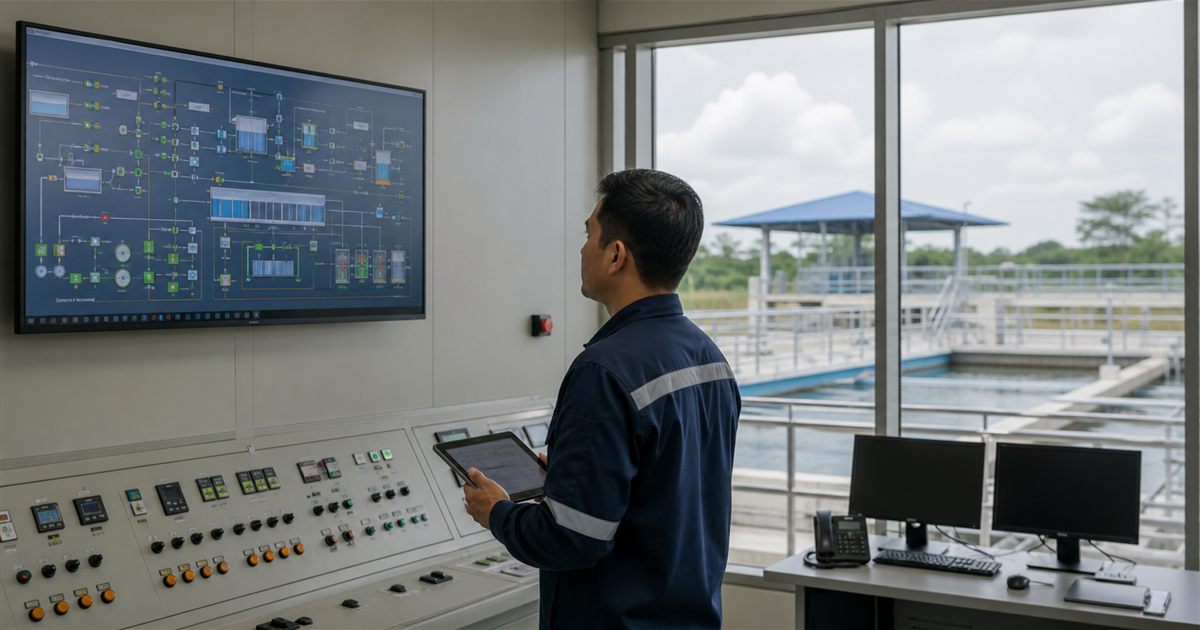
Water and wastewater operators use telemetry to bring information from remote assets into a central operational view. Reservoir levels, pump status, flow, pressure, valve position, alarms and treatment conditions can be monitored without staffing every location. The buying challenge is to turn that visibility into a dependable operating system rather than a collection of disconnected instruments and screens.
A useful procurement brief starts with the decisions operators need to make. It should identify which conditions require immediate action, which values support planning, and which records must be retained. This creates a clearer basis for comparing system integrators, communication methods, control equipment and software scope.
Define the sites and operating objectives
List every treatment plant, reservoir, pumping station, valve chamber and other remote location included in the project. For each site, record the assets, available power, existing instruments, communications coverage, environmental conditions and access restrictions. Buyers should distinguish between monitoring-only locations and sites where remote control will be permitted.
Operational objectives should be specific. Examples include reducing reservoir overflows, identifying pump failures earlier, maintaining pressure, recording treatment performance, improving energy scheduling or providing central alarm visibility. A project with clear objectives is easier to test and less likely to accumulate features that operators do not use.
Separate control, network and data requirements
Telemetry solutions normally involve several connected layers. PLCs or local controllers operate equipment and collect signals. RTUs can gather data and communicate from remote sites. The network transports information. SCADA software presents conditions, alarms, trends and reports to operators. Buyers should request a clear architecture showing responsibility at each layer.
Local control should continue safely when communication to the central system is interrupted. The specification should state what happens during a network outage, power loss, invalid reading or equipment fault. This fail-safe behaviour is more important than how many screens or data points are included.
Select monitoring points by operational value
More data does not automatically create better control. Each point adds design, configuration, testing, storage and maintenance work. Buyers should classify points as critical control, alarm, operational monitoring or management reporting. This helps determine update frequency, alarm priority, historical storage and display requirements.
Signal lists should use consistent names, units, ranges and status definitions. Pump running, available, faulted and locally isolated are different conditions. If point definitions remain unclear, operators may receive misleading displays and commissioning teams will spend additional time resolving discrepancies.
Compare communication options site by site
Radio, cellular, fibre and other communication methods have different coverage, capacity, ownership and recurring-cost implications. One method may not suit every site. Buyers should request survey evidence, expected availability, recovery behaviour and a plan for weak or failed links. Remote locations may also need backup power and secure enclosures.
Cybersecurity requirements should be agreed with the asset owner. Network separation, user access, remote support, device configuration, updates and event records need defined responsibility. Procurement teams should avoid treating security as an optional software feature added after the architecture is selected.
Make the HMI useful for operators
SCADA graphics should help users identify abnormal conditions and move from overview to detail. Excessive colour, decorative three-dimensional equipment and crowded screens can make alarms harder to see. Buyers should involve operators in reviewing screen hierarchy, naming, trends, alarm priorities and acknowledgement workflows.
Reports should also answer defined questions. Daily flows, reservoir performance, pump runtime, energy use, alarm frequency and communication availability may support different teams. Confirm who needs each report, how often it is produced and how long data must be retained.
Evaluate the complete service scope
A telemetry project may include feasibility, detailed design, panel manufacture, PLC programming, RTU configuration, SCADA development, network setup, installation, testing, commissioning, training and maintenance. Quotations should identify what is included, what the client supplies and how existing equipment will be integrated.
Project capability example: Hydro-Trent describes design, installation, PLC and SCADA configuration, testing, commissioning and operational support for water and wastewater applications. Its telemetry systems service page can help project teams identify questions about scope and integration responsibility. The final comparison should still confirm project-specific deliverables, acceptance criteria, warranties and support terms.
Plan acceptance and long-term support
Acceptance testing should prove every critical point, alarm, command, trend and report. It should also cover communication failure, power restoration, incorrect signals and user permissions. Factory testing can resolve configuration issues before site work, while site testing confirms the installed system and field devices operate together.
Buyers should also define how additions will be priced after handover. New sites, points, reports and user workstations may require hardware, engineering and software licences. A schedule of rates or expansion assumptions makes future cost less uncertain and helps the owner avoid an architecture that becomes disproportionately expensive to extend.
Final comparison should include drawings, source files, software licences, backups, passwords, training, spare equipment, response times and preventive maintenance. A lower installation price may provide poor value if the operator cannot maintain, expand or recover the system. The strongest selection is the solution that meets operational objectives, performs predictably during faults and has a support model the asset owner can sustain.
Buyer references
- NIST SP 800-82 Rev. 3: operational technology securityUse this guide when comparing security and lifecycle requirements.
- US EPA: cybersecurity for the water sectorReview water-sector resources alongside local project requirements.