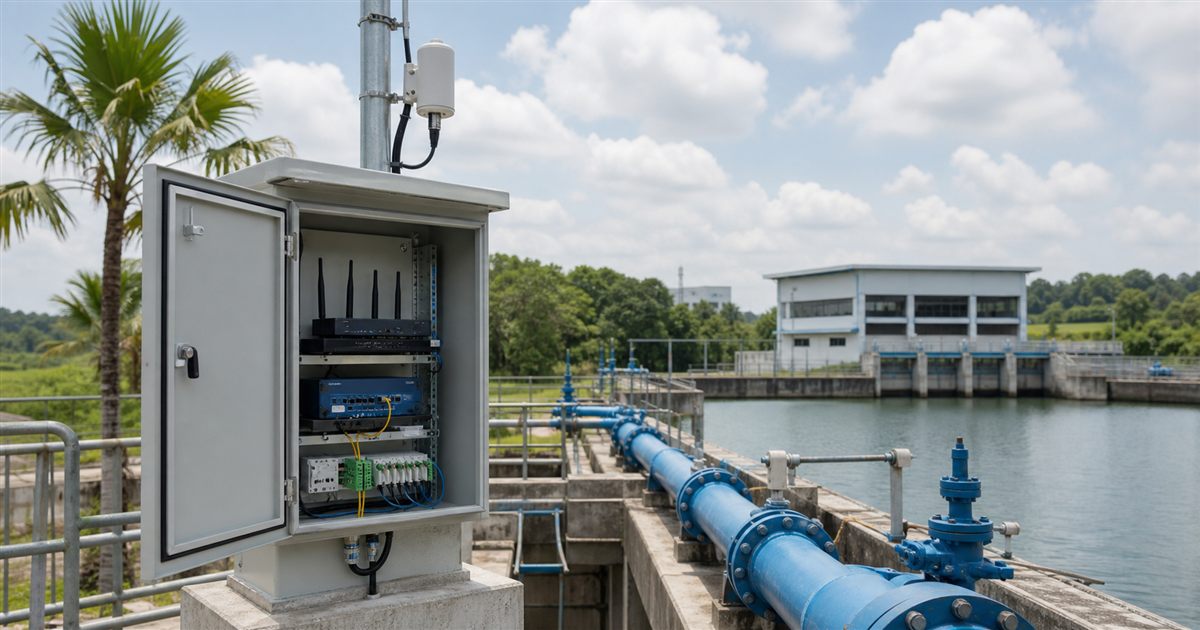
Water telemetry networks connect control centres with treatment plants, reservoirs, pumping stations and other remote assets. Site geography, existing infrastructure, data requirements and operating consequence vary widely, so one communication method may not suit the full project. Buyers should compare each option at site level and consider how the complete network will be monitored and supported.
Begin with communication requirements
List the data volume, update rate, alarm urgency and remote-control needs for every site. A reservoir sending periodic level values has different requirements from a treatment plant carrying many real-time points. Video, voice or engineering access can also increase capacity needs beyond normal telemetry data.
Define acceptable delay and outage duration. Critical alarms may need rapid delivery or a backup path, while historical values can be stored locally and transferred later. The design should state what local equipment does when the link is unavailable.
Private radio networks
Radio can give utilities greater control over network infrastructure and may suit fixed sites with suitable paths and frequencies. Costs can include surveys, licensing, towers, antennas, repeaters, lightning protection and specialist maintenance. Terrain, buildings and vegetation affect performance.
Buyers should request path studies and field measurements rather than assuming line of sight from a map. The proposal should cover interference, antenna mounting, surge protection, spare equipment and monitoring of radio health. Future sites may require additional repeaters or capacity planning.
Cellular communications
Cellular service can reduce the need for utility-owned radio infrastructure and may be practical for widely distributed sites. It introduces recurring charges and reliance on operator coverage. Signal strength can differ inside enclosures or after network changes, so site testing remains necessary.
Compare service plans, data allowances, addressing, secure connection methods, antenna arrangements and management of subscriber modules. Ask how the system handles provider outages and whether multiple networks or another backup route are justified for critical locations.
Fibre and fixed connections
Fibre can provide high capacity and stable performance where routes already exist or can be installed economically. It may suit treatment plants, control centres and sites along established utility corridors. Civil work, wayleaves, cable damage and repair access can dominate cost and programme.
Ownership boundaries should be clear. If a telecommunications provider supplies the connection, buyers need service commitments and fault escalation. If the utility owns the fibre, it needs records, test equipment, spares and repair arrangements.
Mixed networks are often practical
A project may use fibre for major plants, radio for clustered sites and cellular service for isolated assets. Mixed networks can fit local conditions but increase the number of technologies the owner must monitor and maintain. Gateways and routing should be documented so fault diagnosis remains manageable.
Standardising security, addressing, time synchronisation and network monitoring across different media helps operators see the network as one service. The control centre should distinguish an instrument fault from a site communication failure.
Compare resilience and recovery
Availability depends on more than the communication link. Site power, batteries, antennas, network equipment, environmental protection and central servers all contribute. Ask for a failure analysis showing single points of failure and expected recovery.
Remote units should buffer important data during outages. Buyers need to know storage duration, timestamp accuracy and what happens if storage becomes full. For remote commands, the system should avoid executing stale instructions after reconnection.
Require surveys and acceptance evidence
Desktop studies help create a preliminary design, but field surveys should confirm signal levels, mounting positions, cable routes, power and enclosure conditions. Survey reports need enough detail for another engineer to understand the assumptions. Sites with seasonal vegetation, new development or difficult terrain may require additional margin or an alternative path.
Network acceptance should measure more than whether a connection is present. Tests can cover signal quality, latency, packet loss, failover, reconnection, alarm delivery and recovery of buffered data. An agreed observation period helps expose intermittent problems that may not appear during a short visit.
Include security and support
Network access, encryption, device configuration, remote engineering, software updates and account management require owner-approved controls. Responsibilities between the integrator, telecom provider and utility must be explicit. Default passwords and unmanaged remote access should not reach operational use.
Network monitoring tools should show site availability, link quality and equipment health without requiring engineers to visit every location. Buyers should confirm who receives communication alarms and who performs first diagnosis. Configuration backups, spare routers or radios, antenna parts and subscriber records should be included in the maintenance plan.
The main guide to selecting telemetry systems places network decisions alongside PLC, RTU, SCADA and support requirements. Communication should be evaluated as part of the operational system, not as a separate commodity connection.
Contract terms should address recurring fees and service changes. Cellular plans, leased circuits, frequency licences and managed network services may be priced separately from the integrator’s support. Buyers need renewal dates, ownership records and escalation contacts so services do not lapse after project personnel move on.
A like-for-like comparison includes equipment, surveys, licences, civil works, subscriptions, backup power, monitoring tools, spares and maintenance. The preferred design may use different media, but it should give operators clear visibility and provide a realistic recovery route when a link fails.
Buyer references
- NIST SP 800-82 Rev. 3: operational technology securityReview network architecture and security considerations for operational technology.
- CISA, EPA and FBI: top cyber actions for water systemsConsider the official actions when specifying connected telemetry networks.