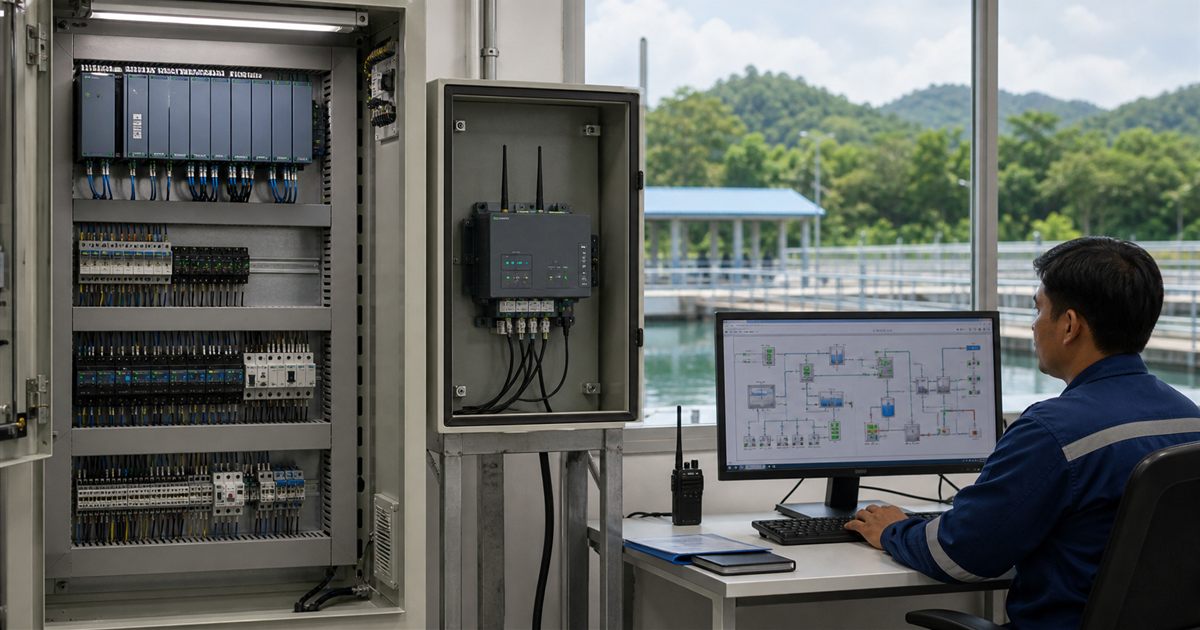
PLC, RTU and SCADA are often grouped together in automation proposals, but they are not interchangeable products. A programmable logic controller manages local process logic. A remote terminal unit is designed to collect and communicate data from remote assets. SCADA provides the supervisory view used to monitor, alarm, trend and sometimes command multiple sites. The boundaries can overlap, so buyers should compare the required functions rather than purchasing by label.
PLC: dependable local control
A PLC normally sits close to pumps, valves, treatment equipment or process instruments. It reads inputs, executes programmed logic and operates outputs. At a pumping station, the PLC may start and stop pumps according to level, pressure, duty rotation and fault conditions. This logic should continue safely even when the central network or SCADA server is unavailable.
Buyers should compare input and output capacity, environmental suitability, redundancy needs, expansion space, programming standards and availability of replacement modules. The PLC brand matters less than its fit with the owner’s installed base, maintenance capability and long-term support. The proposal should also state who owns the source code and how backups are controlled.
RTU: communication from remote sites
An RTU is commonly used at reservoirs, valve chambers, boreholes and smaller pumping locations where communications and power conditions differ from a main plant. It gathers instrument readings and equipment status, stores data when links fail and sends information to the control centre. Some RTUs also perform local logic.
Evaluation points include communication interfaces, power consumption, battery or solar compatibility, data buffering, time synchronisation, environmental protection and remote diagnostic capability. Buyers should confirm how the unit recovers after communication loss and whether critical alarms can use an alternative route.
SCADA: the operational picture
SCADA software receives information from PLCs and RTUs and turns it into displays, alarms, trends, histories and reports. It may cover one treatment plant or a network of many remote sites. Its value depends on the quality of point configuration, screen design and alarm management rather than the number of graphical effects.
Compare server architecture, workstation requirements, licensing, data retention, user permissions, backup and recovery, reporting tools and support for future sites. Operators should participate in screen and alarm reviews. A technically complete SCADA system can still be difficult to operate if naming is inconsistent or abnormal conditions are hidden in crowded displays.
Decide where each function belongs
The project architecture should state which decisions happen locally and which happen centrally. Pump protection and essential sequencing usually remain local. Central SCADA can provide setpoints, schedules or supervisory commands where the operating policy allows. Remote control should include confirmation, permissions and interlocks that prevent unsafe operation.
Buyers should also ask what happens when one layer fails. If SCADA is offline, the plant should maintain safe local operation. If communications fail, the RTU should retain important records and reconnect predictably. If a field signal becomes invalid, the PLC should use defined fallback logic and alert operators.
Compare integration effort
Existing sites may contain equipment from several manufacturers and different generations. Integration can require protocol conversion, additional gateways, revised programming or replacement of unsupported components. Ask bidders to identify assumptions about existing drawings, software access, licences and available spare capacity.
Point lists are central to the integration. Every signal needs a source, address, engineering unit, range, alarm condition, update rule and display destination. Unresolved point definitions create testing delays and unreliable information. The owner should approve the final list and receive it as part of the handover package.
Use lifecycle requirements to guide selection
A common platform can simplify training and spares, but complete standardisation is not always practical. Buyers should weigh compatibility, supplier availability, cybersecurity support, software tools and expected product lifecycle. Proprietary features may solve a current requirement while making future integration more dependent on one provider.
Panel and workstation quantities should include realistic expansion. Spare PLC input/output capacity, cabinet space, network ports, server resources and SCADA point licences can reduce the cost of modest future changes. Excessive unused capacity also has a cost, so bidders should state the allowance and how it was calculated.
Commercial comparison should identify recurring expenses. SCADA support agreements, software updates, cellular subscriptions, remote-access services and specialist programming tools may continue after the project warranty. Buyers should distinguish mandatory charges from optional services and confirm which licences are permanent, subscription-based or limited by point count and workstation quantity.
The broader guide to selecting telemetry systems for water operations explains how these layers fit into operational objectives, network choices and supplier scope. The final architecture should be understandable to operators and maintainers, not only to the system designer.
Training needs should be assessed by layer. Instrument and electrical teams may need PLC and RTU diagnostics, control-room users need SCADA navigation and alarm handling, while administrators need backup, security and user-management procedures. A single product demonstration does not prepare each group for its responsibilities.
A useful quotation separates PLC hardware and programming, RTU equipment and communications, SCADA software and configuration, licences, testing, training and support. That breakdown helps buyers compare equivalent scope and understand where future expansion costs may arise.
Buyer references
- NIST SP 800-82 Rev. 3: operational technology securityReference the roles and security considerations of industrial control components.
- US EPA: cybersecurity for the water sectorUse the sector guidance to inform control-system risk discussions.