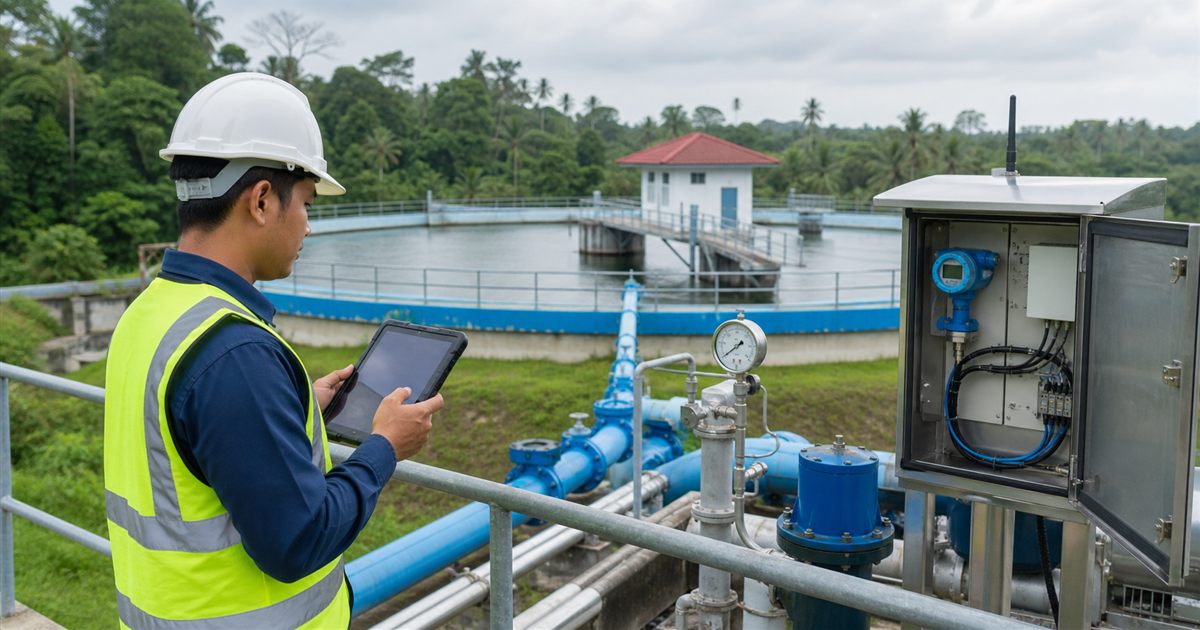
Water infrastructure is distributed across wide service areas, and many sites cannot justify permanent staffing. Remote monitoring allows a control centre to see operating conditions, receive alarms and review historical performance. The design should reflect the risks and decisions at each asset rather than applying the same standard point list everywhere.
Reservoirs: protect storage and supply
Reservoir monitoring commonly includes water level, inlet and outlet flow, valve status, power condition, access alarms and communication health. High and low level alarms should be set against actual operating limits. Buyers should distinguish between a warning that gives operators time to respond and a critical condition requiring immediate escalation.
Level measurement needs a defined validation method. A failed or drifting instrument can produce misleading decisions, so systems may compare signals, check rate of change or flag implausible values. The design should also specify what happens when level data is unavailable and whether local controls continue independently.
Pumping stations: monitor condition and duty
For pumps, simple running status is rarely enough. Useful points may include available, selected duty, running, stopped, faulted, locally isolated, trip cause, runtime, start count, suction pressure, discharge pressure, flow and wet-well level. The exact requirement depends on station type and operating strategy.
Alarm priorities should reflect consequence. A standby pump unavailable may be important before demand increases, while all pumps unavailable is immediately critical. Frequent starts, low flow or unexpected pressure can indicate developing issues. Historical trends help maintenance teams investigate events that are not visible from a single current value.
Treatment plants: connect process and equipment information
Treatment monitoring may combine process measurements, equipment status, chemical systems, tank levels, quality indicators and power information. Buyers should identify which data supports control, compliance records, operational review and management reporting. Different purposes can require different sampling and retention periods.
Instrument reliability affects the value of every display. The project should include ranges, engineering units, calibration expectations, invalid-signal handling and maintenance access. A polished SCADA trend cannot correct a poorly installed or unsuitable field instrument.
Design alarms around operator response
Every configured alarm should have an owner and an expected response. If operators cannot act on a condition, it may be better presented as an event or maintenance notification. Excessive low-value alarms can hide urgent conditions and reduce confidence in the system.
Alarm messages should identify the site, equipment and condition clearly. Escalation may include control-room display, SMS or another notification route, but buyers should confirm delivery, acknowledgement and fallback behaviour. Communication failure itself needs monitoring because a silent site can appear normal when no data is arriving.
Account for remote-site constraints
Remote sites may have limited power, weak communications, lightning exposure, heat, humidity, flooding risk or difficult access. Enclosures, surge protection, antennas, batteries and environmental ratings should match actual conditions. Maintenance teams need safe access to instruments and communication equipment.
Data buffering is important where links are intermittent. Ask how much information the remote unit stores, whether timestamps are preserved and how records are transferred after reconnection. Critical control should not depend solely on continuous communication.
Prioritise sites for phased delivery
Utilities do not always need to connect every asset in one project. Buyers can rank sites by supply consequence, incident history, travel time, existing instrumentation and communication readiness. A pilot group should include representative conditions rather than only the easiest locations. Lessons from installation, alarm settings and operator use can then improve later phases.
Phasing needs a stable naming and addressing standard from the start. Otherwise, each expansion can create inconsistent site codes, equipment names and report formats. The initial design should show how new sites will be added without rebuilding the control-room navigation or exceeding licence limits unexpectedly.
Compare the operational result
Supplier proposals should show point quantities by site, communication assumptions, screen hierarchy, alarm rules, historical storage and test methods. A demonstration using representative sites can reveal whether navigation and naming make sense to operators. The system should make abnormal conditions easier to identify, not require users to search through many screens.
Data quality should be visible to users. Stale values, communication loss, instrument faults and substituted readings must not appear as normal live measurements. Buyers should request clear status indications and rules for excluding invalid data from reports. This prevents management summaries from presenting gaps or failed signals as genuine process performance.
Our main guide to telemetry systems for water and wastewater operations covers architecture, supplier scope and lifecycle support. Remote monitoring requirements should feed directly into that broader procurement specification.
Service arrangements should recognise that remote faults may involve several parties. An alarm problem could come from the instrument, RTU, communication provider, central network or SCADA configuration. The contract should define initial diagnosis, escalation and access responsibilities so the owner is not left coordinating suppliers during an operational incident.
Success can be measured through improved alarm response, fewer unnecessary site visits, better incident records, reduced overflows or more informed pump scheduling. Buyers should agree on the expected operational benefit before approving the final point count. That keeps investment focused on information the utility can use and maintain.
Buyer references
- US EPA: cybersecurity for the water sectorReview current resources for protecting connected water infrastructure.
- CISA, EPA and FBI: top cyber actions for water systemsUse the recommended actions when assessing remote access and monitoring controls.